
- Hospital Furniture
- Neonatal Care Product
- Operating Surgical Tables
- Orthopedic Implants
- Surgical Operating Led Lights
- Orthopedic External Fixators
- Laryngoscopes
- Orthopaedic Power Tools
- Medical Disposables
- Hospital Clothing
- Anaesthesia Products
- Autoclaves & Sterilizers
- Hospital Holloware
- Suction Units
- Rehabilitation Aids
- Stethoscopes
- Anesthesia Machine & Ventilators
- Cold Chain Equipment
- Electro Medical Equipments
- Orthopedic Instruments
- Surgical Operating Led Lights
- Physiotherapy products
Best PEEK Interference Screw Manufacturer in China
Choosing the Best Peek Interference Screw Manufacturer in China requires more than comparing prices or product photographs. Surgeons and procurement teams need to assess material traceability, dimensional consistency, manufacturing controls, and clear technical documentation. A Peek Interference Screw must fit its intended tunnel and graft configuration; small differences in thread geometry or insertion features can matter during surgery. Details count.
PEEK is valued for its radiolucency and mechanical properties, but those features alone do not establish clinical suitability. Buyers should review the device’s intended use, validated specifications, quality records, and available evidence with qualified clinical and regulatory professionals. Ask how the manufacturer monitors critical dimensions, manages lot identification, and handles design changes. Request the actual records, not just a polished brochure. No screw is right for every reconstruction.
Dr. Freddie H. Fu, a widely recognized ACL surgeon and researcher, is relevant to this discussion because of his work on ligament reconstruction. I cannot verify a verbatim statement from him about PEEK interference screws, so I will not invent one. A practical, clearly labeled paraphrase of a broader reconstruction principle is: “Evaluate fixation as part of the whole reconstruction, not as an isolated implant.” That distinction matters. This guide examines what buyers can verify when evaluating Chinese manufacturers, from material and process controls to product support, while recognizing that manufacturing claims still need independent scrutiny.
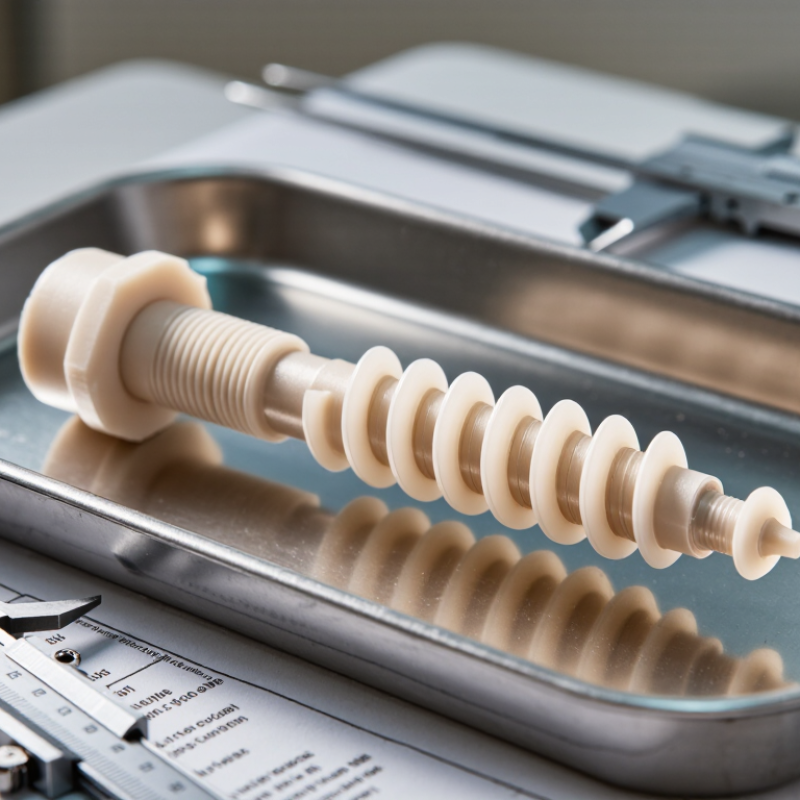
Table of Contents [Hide]
What Is a PEEK Interference Screw?
What Is a PEEK Interference Screw?
A PEEK interference screw is a fixation device used to secure a tendon graft inside a drilled bone tunnel, often during ligament reconstruction. As the screw advances beside the graft, it presses the tissue against the tunnel wall.
The fit matters. Too little compression can weaken fixation; excessive force may damage the graft or surrounding bone.
PEEK means polyether ether ketone, a strong, non-metallic polymer. A 2007 review by Kurtz and Devine in Biomaterials reports an elastic modulus of about 3.6 GPa for unfilled PEEK. This material property helps explain why PEEK can provide firm fixation while remaining visible as a screw outline on imaging, rather than obscuring nearby anatomy like some metals.
It is not a passive plug. Screw length, diameter, thread design, tunnel size, and bone quality all affect performance, so the material alone cannot predict clinical results. Surgeons also weigh the need for secure graft fixation against possible imaging or revision considerations.
PEEK is not ideal for every case. The evidence and device design should be assessed together.


