
- Hospital Furniture
- Neonatal Care Product
- Operating Surgical Tables
- Orthopedic Implants
- Surgical Operating Led Lights
- Orthopedic External Fixators
- Laryngoscopes
- Orthopaedic Power Tools
- Medical Disposables
- Hospital Clothing
- Anaesthesia Products
- Autoclaves & Sterilizers
- Hospital Holloware
- Suction Units
- Rehabilitation Aids
- Stethoscopes
- Anesthesia Machine & Ventilators
- Cold Chain Equipment
- Electro Medical Equipments
- Orthopedic Instruments
- Surgical Operating Led Lights
- Physiotherapy products
What Is a Red Light Therapy Bed and How Does It Work?
A Red Light Therapy Bed is a full-body wellness device that uses red and near-infrared light. Its panels usually surround the user while they lie comfortably on a padded surface. The light reaches the skin without ultraviolet radiation, tanning, or intense heat. Many people describe the session as calm, warm, and surprisingly uneventful.
Michael R. Hamblin, PhD, a widely cited photobiomodulation researcher, describes the principle simply: “Photobiomodulation is the use of light to stimulate biological processes.” In practical terms, specific wavelengths may interact with cellular structures and influence energy production. Research has explored possible benefits involving skin appearance, temporary muscle comfort, and recovery. However, results can differ between individuals, devices, and treatment schedules.
The technology is not magic.
A professional explanation must include uncertainty. Some commercial claims move faster than the evidence, especially when they promise dramatic or universal results. Device quality also matters. Wavelength, irradiance, treatment distance, exposure time, and eye protection can change the experience. A bright bed is not automatically a better bed.
This guide examines what a Red Light Therapy Bed does, how its light may work, and what users should realistically expect. It also considers practical details, including session length, comfort, safety precautions, and the limits of current research. The goal is not to oversell the treatment. It is to make the technology easier to understand before someone steps beneath the glowing panels.
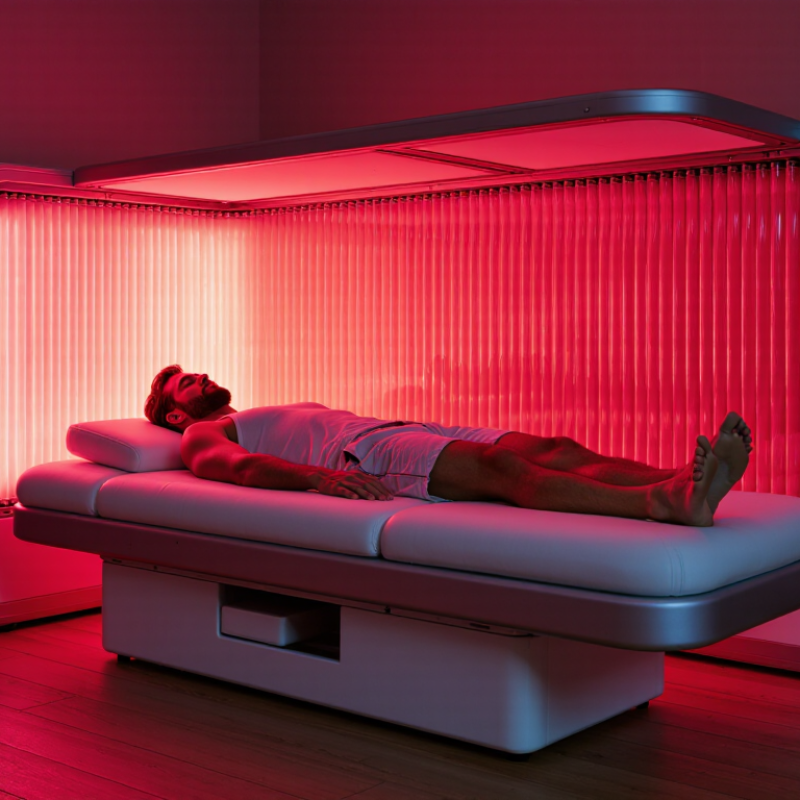
Table of Contents [Hide]
Red Light Therapy Bed Definition: Full-Body LEDs Using Red and Near-Infrared Light
A red light therapy bed is a full-body photobiomodulation device. It uses rows of LEDs to expose the skin to red light and near-infrared light. Red wavelengths commonly sit near 630–660 nanometers, while near-infrared wavelengths often range from 810–850 nanometers. Red light mainly reaches surface tissues. Near-infrared light can travel deeper into soft tissue. Cells absorb this energy through mitochondrial structures, which may support ATP production and normal cellular repair processes.
The Global Wellness Institute reported that the wellness economy reached about $6.3 trillion in 2023. That growth reflects rising interest, not guaranteed results. A 2023 review in Photobiomodulation, Photomedicine, and Laser Surgery found potential benefits for skin appearance, pain, and recovery, but protocols differed widely. Treatment time, irradiance, distance, and wavelength all matter. More light is not automatically better. That part is often misunderstood.
Tips: Check the device’s wavelength, irradiance, and treatment distance before use. Follow the stated session time, and protect your eyes when instructions require it. Take clear photos under the same lighting. Changes can be subtle. People with photosensitive conditions or medication use should seek professional advice first. Results may vary, and some claims remain stronger than the available evidence.


